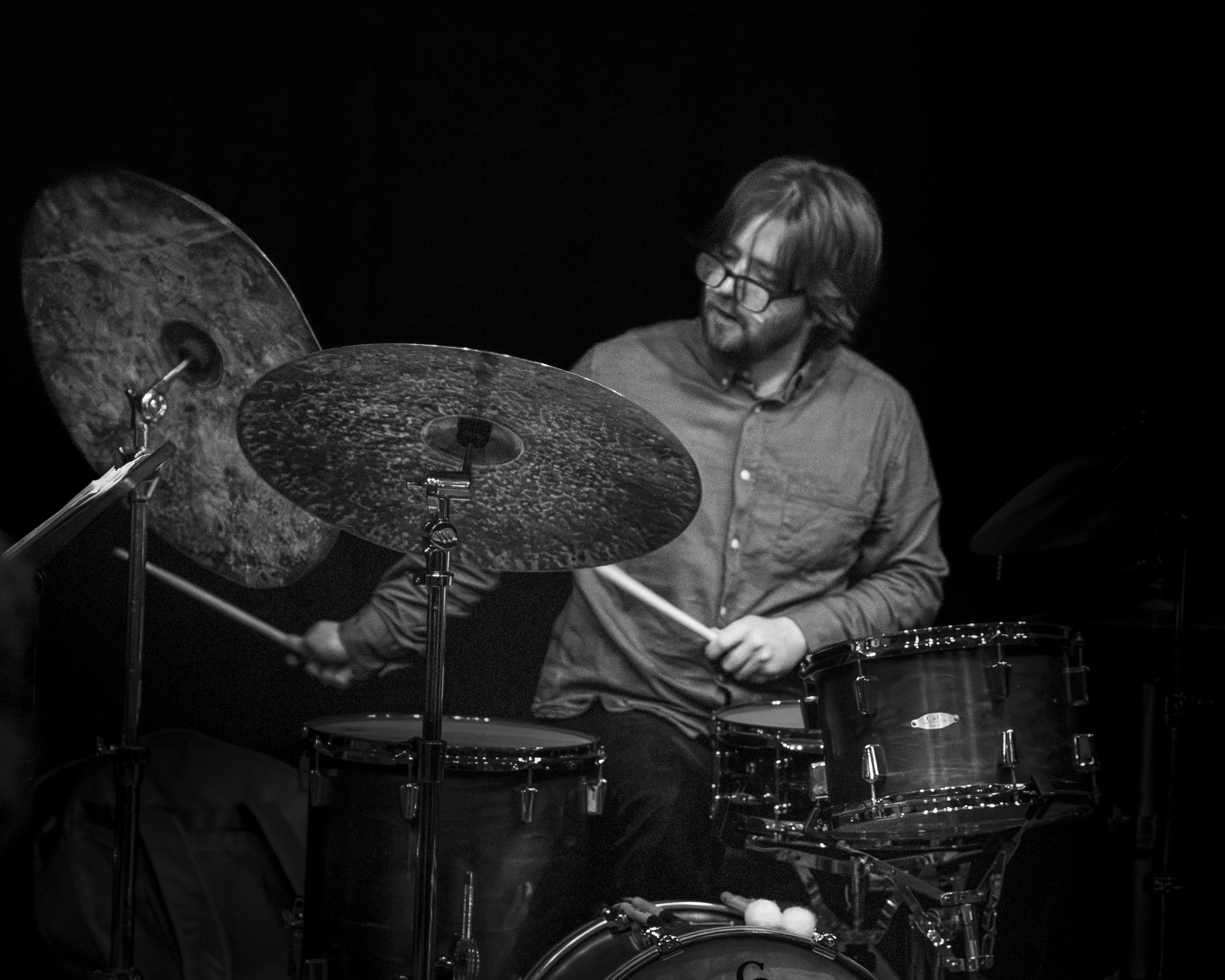
Photo by Tim Schmoll
Adam Shead
Percussionist, Composer, Improviser, Performance Curator
Adam Shead is a Chicago-based percussionist, composer, improviser, and performance curator whose work explores the intersections of contemporary improvised music, experimental composition, and collective artistic expression. Known for his expansive approach to percussion, polyrhythmic complexity, and unconventional orchestration of the drumset, Shead has established himself as a distinctive voice in contemporary creative music, both as a performer and as an advocate for Chicago's improvised music community.
Born and raised in Mishawaka, Indiana, Shead began studying drums at the age of twelve, following brief explorations of the violin and trumpet. His earliest percussion teacher was the legendary Billy "Stix" Nicks, whose career included performances with Jr. Walker & the All Stars, Aretha Franklin, and the Temptations. In 2011, Shead relocated to Chicago to pursue undergraduate studies at Columbia College Chicago, where he earned a Bachelor of Music in Instrumental Performance. He later attended the University of Michigan, earning a Master of Music in Contemporary Improvisation and a Graduate Certificate in Performance Studies. Throughout his undergraduate and graduate education, Shead further developed his instrumental and compositional practice, studying percussion with Jarrett Hicks, Tom Hipskind, Ruben Alvarez, and Michael Gould, and composition with Andrew Bishop, Kenn Kumpf, Mark Kirschenmann, and Dennis Luxion. These formative academic experiences helped shape his approach to musical structure, blending compositional rigor with the spontaneity of collective improvisation.
An active bandleader and collaborator, Shead leads or co-leads several prominent ensembles, including microplastique, the Adiaphora Orchestra, the Stein/Smith/Shead Trio, and Timekillers. His work encompasses a broad spectrum of contemporary musical practices, from intimate free improvisation and small-group composition to large-ensemble experimentation. Throughout his career, he has performed and recorded with an extraordinary range of internationally recognized musicians, including Marilyn Crispell, Roscoe Mitchell, Wadada Leo Smith, Jason Stein, Damon Smith, John Dikeman, Mary Oliver, Steve Swell, Keefe Jackson, Andreas Røysum, and numerous others.
Shead has recorded more than thirteen albums as a leader or co-leader, earning consistent critical recognition for his inventive percussion vocabulary and dynamic contributions to collective improvisation. His playing is characterized by an unusually expansive conception of the drumset, incorporating bells, woodblocks, metallic resonances, unconventional sound sources, and intricate rhythmic structures into a highly personal musical language. Rather than treating percussion solely as a rhythmic foundation, Shead approaches the instrument as an orchestral and melodic voice, engaging in continuous dialogue with his collaborators.
Writing about the Stein/Smith/Shead Trio's 2026 release Five Nights in the Midwest, Brian Earley of the Free Jazz Collective drew a striking comparison between Shead and pioneering percussionist Milford Graves:
"Shead’s drumming, for instance, reminds me of Milford Graves. I know, I know, this is a bold comparison. But Shead’s polyrhythmic dexterity sometimes makes me think he must have eight arms, and the professor is the one of the few other drummers that elicit this response in me."
Critic Ken Waxman of JazzWord has similarly highlighted Shead's unconventional approach to percussion, describing his use of galloping rhythmic figures, bell-like resonances, woody articulations, metallic scrapes, and other idiomatic textures that extend far beyond conventional drumset vocabulary. These observations reflect Shead's commitment to developing a percussion language in which rhythm, timbre, melody, and texture function as equally significant elements of musical expression.
Among his most celebrated recordings is a 2024 studio collaboration with pianist Marilyn Crispell, bass clarinetist Jason Stein, and bassist Damon Smith, which was recognized among the year's leading jazz releases in the NPR Francis Davis Jazz Critics Poll. His extensive discography documents an ongoing commitment to adventurous ensemble practices, long-term artistic partnerships, and the development of original compositional frameworks for improvisation.
A prolific touring musician, Shead has participated in more than fifteen multi-state concert tours over the past decade, performing with ensembles including Cellular Chaos, microplastique, the Stein/Smith/Shead Trio, the Keefe Jackson/Jakob Heinemann Quartet, Will McKenna's Undisclosed Sims, and numerous other collaborative and ad hoc improvising groups. His performances have taken him to internationally recognized venues, museums, and festivals, including the Art Institute of Chicago, Ann Arbor's Edgefest, Amalgam Fest, Amsterdam's The Present Is Present festival, and Milwaukee's Charles Allis Art Museum, among others.
Beyond his work as a performer and composer, Shead has played a substantial role in cultivating and sustaining Chicago's experimental music community. As a performance curator, arts administrator, and community organizer, he has produced more than 500 concerts, workshops, and community initiatives dedicated to improvised and experimental music through organizations and venues including Slate Arts and Performance, Comfort Station, and Rembrandt Chamber Musicians. His curatorial practice emphasizes artistic experimentation, intergenerational collaboration, and the creation of accessible spaces where musicians and audiences can encounter new forms of creative expression.
For five nonconsecutive years, Shead organized and facilitated Impro Jam, a Chicago-based creative improvisation workshop welcoming musicians of all backgrounds and experience levels. Over the course of more than seventy-five workshops, the series provided a collaborative environment for participants to explore spontaneous composition, collective listening, and improvisational techniques outside traditional musical hierarchies. The initiative reflected Shead's broader commitment to fostering artistic communities through participation, mentorship, and shared experimentation.
Today, Shead continues to maintain an active international performance, recording, and curatorial practice, balancing his work as an improviser and composer with his commitment to expanding opportunities for adventurous music. Whether leading his own ensembles, collaborating with pioneering figures in creative music, or developing platforms for emerging artists, his work is united by a belief in improvisation as a vital form of artistic inquiry, collective discovery, and community engagement.